Skip to content


A whole home generator is one of those things you buy hoping you’ll rarely need it — but when you do, it has to work. No exceptions.
And that’s where a lot of homeowners run into trouble. The generator gets installed, it sits quietly on the side of the house, and nobody thinks about it again until the power goes out. By then, it’s too late to find out something’s wrong.
We’ve been installing and servicing generators in Central Mississippi for years, and we’ve seen what happens when maintenance is put off: the system doesn’t work when you need it. It’s not a fun phone call to get, and it’s an even less fun one to make.
This article is for anyone who owns a whole-home generator — whether it’s brand new or 10 years old — and wants to know exactly what regular maintenance it needs to stay reliable. We’re going to walk through everything: what you can handle yourself, what needs a professional, and how often each task should happen.
How Often Should You Run Your Generator (Even When the Power’s On)?
This is the single most overlooked piece of generator ownership. Your generator needs to run regularly, even when the weather is clear and the power is perfectly fine.
Most modern whole-home generators come with a built-in weekly exercise cycle. The unit will automatically start up and run for about 15 to 20 minutes, usually once a week. This does a few things: it keeps the engine lubricated, charges the battery, and circulates oil and coolant through the system so nothing sits stagnant.
Here’s the thing — a lot of homeowners don’t realize this feature exists, or they don’t know if it’s actually running. Step outside during the scheduled time once a month and listen for it. If the unit isn’t cycling, something is off, and you want to know that now rather than during a major storm.
If your generator is an older model that doesn’t have an automatic exercise mode, you’ll need to start it manually. Run it for at least 10 to 15 minutes once a month at a minimum.
Think of it like a car that sits in the garage for six months. You wouldn’t expect it to fire right up and drive smoothly. Your generator is the same way.
What Happens When You Ignore the Battery
If there’s one component responsible for more generator failures than anything else, it’s the battery. And it’s almost always preventable.
Your generator’s battery is what kicks the whole system into action when it detects a power outage. No battery power, no automatic start. That means when the lights go out, your generator just sits there — and so do you.
Generator batteries typically last two to three years, sometimes a little longer, depending on the climate and how often the unit runs. Here in Mississippi, heat and humidity can shorten that lifespan.
Check your battery a couple times a year. Look for corrosion on the terminals — white or greenish buildup is a sign things are heading in the wrong direction. If your battery is approaching that two-to-three-year window, replace it proactively. A new battery costs a fraction of what it costs to ride out a multi-day outage without power.
This is one of those small, inexpensive items that makes a massive difference when the stakes are high.
Oil Changes, Air Filters, and Spark Plugs — The Basics That Keep Your Generator Alive
Your generator has an engine. And like every engine, it needs a few basic things to run well and last a long time.
Oil
Dirty or low oil is hard on an engine. It increases friction, generates excess heat, and accelerates wear on internal components. Check your owner’s manual for the recommended oil change schedule — for most whole-home generators, that’s somewhere around every 100 to 200 hours of operation, or at least once a year, whichever comes first.
If your generator ran hard during a recent storm season, it probably logged more hours than you think. Don’t just go by the calendar — factor in actual run time. And always use the oil type and weight the manufacturer recommends.
Air Filter
A dirty air filter restricts airflow to the engine, which means the unit has to work harder to do its job. Here in Mississippi, between the pollen, humidity, and dust, air filters can get clogged faster than the manual might suggest.
Check yours at least twice a year. Hold it up to a light — if you can’t see through it, it’s time for a replacement. It’s a cheap part that has an outsized impact on performance and longevity.
Spark Plugs
Worn or fouled spark plugs cause hard starting, rough running, and in some cases prevent the generator from firing at all. Most manufacturers recommend inspecting or replacing spark plugs once a year.
If your generator has been struggling to start during its exercise cycle or running rough, the spark plugs are one of the first things to look at.
None of these tasks are complicated on their own. But when they get skipped for a year or two, the problems start to stack up — and they usually show up at the worst possible time.
Keeping the Area Around Your Generator Clear (And Why Critters Love It)
Your generator needs room to breathe. It pulls in air to cool the engine and exhaust fumes away from your home. When that airflow is blocked, the unit runs hotter, works harder, and is more likely to shut down or cause safety issues.
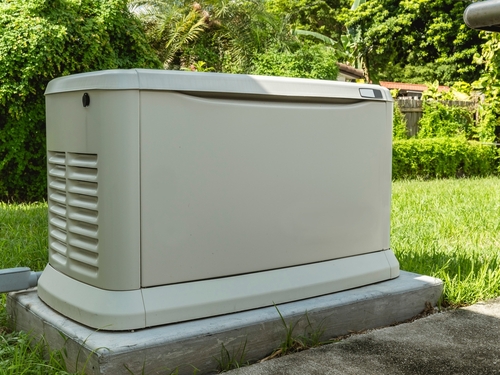
Keep at least three feet of clearance on all sides of the unit. That means trimming back shrubs and hedges, raking away leaves and grass clippings, and making sure nothing is leaning against or stacked near the generator.
In Central Mississippi, vegetation grows fast — especially from spring through fall. A unit that had plenty of clearance in January can be swallowed by landscaping by June. Make it part of your yard routine to check the area around the generator when you’re mowing or trimming.
And then there’s the critter problem. Mice, rats, wasps, and other small animals love to nest inside or underneath generators, especially during periods when the unit isn’t running often. They chew on wires, build nests that block airflow, and create problems that aren’t visible from the outside.
A quick visual inspection every month or two goes a long way toward catching these issues before they cause real damage.
Liquid-Cooled vs. Air-Cooled Generators: Does Maintenance Differ?
Yes, and it’s worth understanding the difference.
Air-cooled generators are the more common type for residential use. They use fans and ambient airflow to regulate engine temperature. The maintenance on these is a bit simpler — oil, filters, spark plugs, battery, and keeping the area clear. The tradeoff is that they rely heavily on good airflow, so keeping the surrounding area clean and unobstructed is even more important.
Liquid-cooled generators are typically found on larger units or homes with higher power demands. These use a coolant system similar to a car engine. That means you’ve got additional maintenance items: checking the coolant level, inspecting hoses for cracks or swelling, and replacing the coolant according to the manufacturer’s schedule.
If you have a liquid-cooled unit, look at the hoses every time you do a visual check on the generator. Soft spots, cracks, or bulging are signs that a hose is getting ready to fail. A busted coolant hose during a power outage means your generator overheats and shuts down — exactly when you can’t afford it.
If you’re not sure which type you have, check your owner’s manual or give us a call. We can help you figure it out and make sure you’re on the right maintenance schedule.
Why an Annual Professional Tune-Up Is Worth the Money
There’s a lot you can do on your own — and we’ve covered most of it above. But some things need a trained technician with the right tools and experience.
A professional maintenance visit typically includes a full inspection of the electrical connections, the automatic transfer switch, the fuel system, and all the internal components that aren’t easy to access or evaluate without training. Your transfer switch alone is a piece of equipment most homeowners don’t even know exists, but if it fails, your generator won’t activate when the power drops.
A technician can also run load tests to make sure the generator performs under real demand, not just during a no-load exercise cycle. There’s a big difference between the unit running with nothing connected and the unit powering your entire home.
We recommend scheduling your annual tune-up before storm season — ideally in the spring. Once severe weather starts rolling through, service schedules fill up fast, and the last thing you want is to be waiting in line when you need your generator most.
The Simple Habit That Makes All of This Easier: Keeping a Maintenance Log
This is the tip that ties everything together, and it takes almost no effort.
Keep a basic log of every maintenance task you perform or have performed on your generator. Write down when you changed the oil, when the battery was replaced, when the air filter was swapped, and when your last professional service visit happened. Note anything unusual — strange sounds, warning lights, error codes.
This does two things. First, it takes the guesswork out of your maintenance schedule. You won’t have to stand in front of your generator wondering when you last changed the oil because you’ll have it written down. Second, it gives any technician who works on your unit a clear picture of its history, which makes their job faster and more accurate.
A notebook in your garage, a note on your phone, a spreadsheet — whatever works for you. The format doesn’t matter. The habit does.
What to Do Next
Your whole-home generator is built to protect your family and home when the power goes out. But it can only do that if it’s been taken care of.
The good news is that most of this maintenance is straightforward, and none of it is expensive — especially compared to the cost of a generator that fails during a storm.
Here’s a quick recap of what to stay on top of:
- Weekly exercise cycles
- Battery checks twice a year
- Oil and filter changes at least annually
- Spark plug inspections
- Keeping the area around the unit clear
- One professional tune-up a year before storm season
If it’s been a while since your generator has had professional attention — or if you’ve never had it serviced — now is the time. Give us a call at (601) 300-2564 to schedule a generator maintenance visit. We’ll go through the entire unit, top to bottom, and make sure it’s ready for whatever Mississippi weather throws your way.