Skip to content


The lights go out. The AC stops humming. Your refrigerator goes silent. If you’ve lived in Mississippi for more than a summer, you know this scenario all too well — and you know that the difference between a minor inconvenience and a major disaster often comes down to what you do in the first few minutes and hours.
Power outages in our area aren’t a matter of if — they’re a matter of when. Whether it’s a summer thunderstorm, an ice event in winter, or a tornado or major storm system pushing through, the grid goes down, and your home is on its own.
Here’s what you need to know to protect your home, your family, and your wallet when it happens.
Step 1: Stay Calm and Assess the Situation
Before you do anything else, figure out what you’re dealing with.
Is it just your house, or is it the whole neighborhood? Check your breaker panel first. If the main breaker has tripped, resetting it may restore power. If your neighbors’ lights are also out, you’re dealing with a utility outage — call your power company to report it and get an estimated restoration time.
Is there a burning smell, sparking, or unusual sounds? If you notice any of these, don’t touch your breaker panel. Leave the house and call an electrician immediately. A fault inside your home — not just a utility outage — can be a serious safety hazard.
Step 2: Protect Your HVAC System
This is one of the most overlooked and most important steps.
Turn your thermostat to “Off” or at least set it to a high setting. When power is restored, the sudden surge can damage your HVAC system’s compressor if it tries to start under load. This is called a hard start, and it can shorten the life of your equipment or cause a failure that requires expensive repairs.
What to expect when power comes back on: Once power is restored, wait 5–10 minutes before turning your AC back on. This gives the refrigerant pressure time to equalize, allowing the system to start smoothly.
If the outage lasts more than a few hours in summer, your home will heat up quickly — especially in Mississippi. A few tips to slow that down:
- Close blinds and curtains to block sunlight
- Keep interior doors open so air circulates evenly
- Avoid cooking on the stove, which adds heat to the home
- Move to the lowest floor of your home, where the air is naturally cooler
If anyone in your household is vulnerable to heat — young children, elderly relatives, or people with medical conditions — don’t wait it out. Find a cool location like a family member’s home or a public indoor place with power.
Step 3: Protect Your Plumbing
Most homeowners don’t think about their plumbing during a power outage, but depending on the situation, it deserves your attention.
If it’s a winter outage, the risk of frozen pipes becomes real fast, especially if temperatures drop below freezing while your heat is out. Here’s what to do:
- Open cabinet doors under sinks to allow warmer room air to reach pipes
- Let a thin trickle of water run from faucets on exterior walls
- Know where your main water shutoff is in case a pipe does freeze and burst
Your water heater may also be affected. Gas water heaters often continue to work during a power outage (unless the ignition is electronic, in which case they won’t). Electric water heaters will not function. This is worth knowing before the first hot shower becomes cold water.
Your sump pump runs on electricity. If you have a space that relies on a sump pump and you’re experiencing a storm-related outage — the very time you most need it — you could face flooding. A battery backup sump pump is worth serious consideration if this is a concern for your home.
Step 4: Handle Food Safety Wisely
Your refrigerator will keep food safe for about 4 hours if you keep the door closed. Your freezer will hold for 24–48 hours, depending on how full it is.
- Resist the urge to open the fridge frequently
- Use a food thermometer — if food is above 40°F for more than two hours, it should be discarded
- When in doubt, throw it out
Step 5: Be Smart About Backup Power
If you’re using generators, candles, or other backup power sources, safety cannot be an afterthought.
Generator safety is serious business. Every year, people are killed by carbon monoxide poisoning from generators being run indoors or in garages. A generator should always be:
- Operated outside, at least 20 feet from windows, doors, and vents
- Never run in a garage — even with the door open
- Connected using heavy-duty, outdoor-rated extension cords, or through a proper transfer switch installed by a licensed electrician
Do not backfeed your home’s electrical system. Plugging a generator directly into a wall outlet is extremely dangerous — it can electrocute utility workers trying to restore power and can damage your home’s wiring. If you want to connect a generator to your home’s electrical panel, a licensed electrician needs to install a transfer switch or interlock kit. This is not a DIY project.
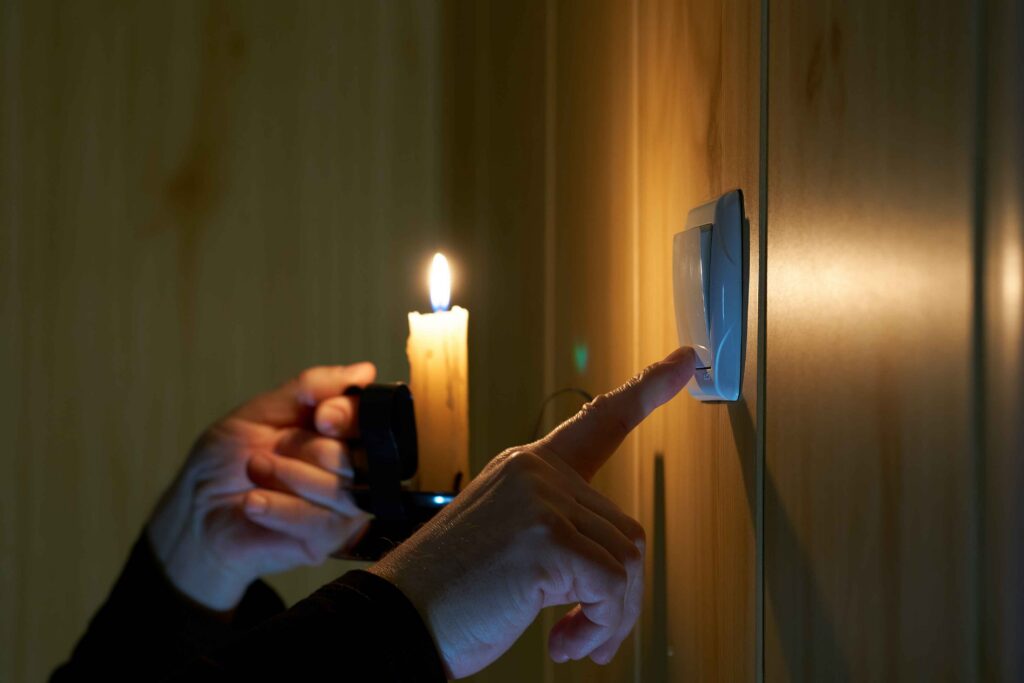
Candles and open flames are a real fire risk during outages. Use battery-powered flashlights and lanterns whenever possible.
Step 6: When Power Is Restored, Do a Full Check
Don’t just flip everything back on and go about your day. Do a quick walkthrough:
- Reset your thermostat gradually — don’t immediately blast the AC. Let the system come up to speed.
- Check your circuit breakers — if any have tripped, investigate why before resetting.
- Inspect your water heater — make sure it’s functioning, and there are no leaks.
- Check for any signs of electrical issues — flickering lights, outlets that don’t work, or burning smells should prompt a call to an electrician.
- Listen to your HVAC system — unusual noises like grinding, clicking, or a system that runs constantly without cooling may indicate damage from the power event.
The Best Protection Is Preparation Before the Outage Happens
Here’s the truth: the homeowners who come through power outages with the least damage and the least stress are the ones who prepared before the lights went out. Here’s what that looks like:
Get a whole-home standby generator installed. Unlike portable generators, a standby generator automatically turns on within seconds when power goes out. It runs on natural gas or propane, so you don’t have to store fuel or haul it out of the garage in a storm. It protects your HVAC system, your refrigerator, your sump pump, your lights, and your peace of mind. This is one of the best investments a Mississippi homeowner can make.
Have your HVAC system serviced regularly. A well-maintained system is more resilient and recovers more smoothly from power events. It’s also far less likely to fail at the worst moment — like when it has to restart after a long outage during a heat wave.
Know where your shutoffs are. Every adult in your home should know where the main electrical panel, the main water shutoff, and the gas shutoff are located and how to operate them.
Have a battery backup for your sump pump if you have one.
Consider a whole-home surge protector. When power is restored after an outage, voltage surges can damage electronics and appliances. A whole-home surge protector, installed at your panel by a licensed electrician, guards against this.
How Environment Masters Can Help
Environment Masters has been serving homes in Central Mississippi for over 60 years. We understand what Mississippi homeowners face — the heat, the storms, and the very real need for systems you can count on when things go sideways.
Our team handles:
- Generator installation — We can help you select and install a whole-home standby generator, so you’re never caught off guard again
- Electrical panel inspections and surge protection — Our licensed electricians will make sure your home is protected, and your electrical system is sound
- HVAC tune-ups and maintenance — So your system is ready to perform when you need it most
- Plumbing inspections — Including sump pump evaluation and water heater checks
If you experienced a recent outage and you’re not sure how your systems held up — or if you want to be genuinely prepared for the next one, we’re here to help.
Give us a call at (601) 300-2564 or schedule online. We’ll come to you, walk you through your options, and take care of it — hassle-free.